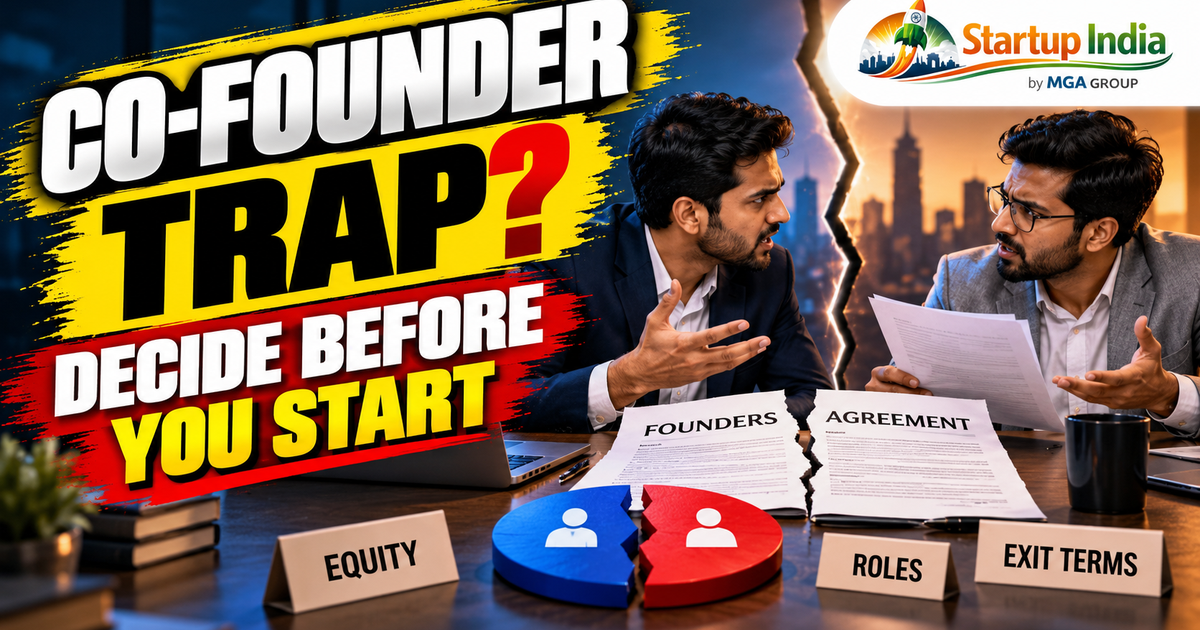
Almost no co-founder team breaks up over the business idea. They break up over the conversation they never had - who owns what, who decides what, and what happens if one of them wants out.
10
Decisions to make before day one
65%
Startups estimated to fail from internal conflict
4yr
Typical founder vesting period
1
Agreement that prevents most disputes
Why Co-Founder Disputes Happen So Often
Founding a company with someone feels like a relationship built on excitement and trust, so the practical, slightly awkward conversations - money, control, what-ifs - get skipped in favour of just getting started. That gap doesn't disappear; it just waits for a stressful moment to surface.
If you're still validating the idea itself, it's worth confirming product-market fit together first - shared conviction under real pressure tells you a lot about how a partnership will hold up later.
1. Exactly How Equity Will Be Split
Not a vague “we'll figure it out later” - an actual number, agreed and documented, based on contribution, risk taken, and time commitment. Our detailed guide on equity distribution walks through contribution-based models if a straight 50-50 split doesn't feel right for your situation.
2. Whether Equity Vests Over Time
Vesting protects everyone - if a co-founder leaves after three months, they shouldn't walk away with the same ownership as someone who stays for four years. A standard structure with a one-year cliff protects both the company and the founders who stay.
3. Who Has Final Say on Which Decisions
Not every decision needs consensus, and pretending otherwise slows the company down. Define upfront which calls need both founders' sign-off - hiring, spending above a threshold, fundraising terms - and which calls each founder can make alone within their domain.
4. What Each Founder Is Actually Responsible For
Overlapping, undefined roles create quiet resentment - one founder feels like they're carrying more, the other doesn't realise it. Clear lanes, reviewed every few months as the company changes, prevent this from festering.
5. How Much Each Founder Is Paid, and When That Changes
Salary disparities - even small ones - become symbolic fights if they were never explicitly agreed. Decide the starting salary structure and the conditions under which it changes, tied to funding milestones or revenue, not just whoever asks first.
6. What Happens If a Co-Founder Wants to Leave
7. How Disagreements Get Resolved
A deadlock clause - mediation, a tie-breaking advisor, or a pre-agreed arbitration process - keeps a single disagreement from freezing the entire company. Without one, two equal co-founders can deadlock indefinitely on something as simple as a hiring decision.
8. Who Owns the IP the Company Is Built On
Code, designs, and content created by founders before formal incorporation can legally remain personal property unless explicitly assigned to the company. This becomes a serious problem during fundraising or an acquisition if it was never cleaned up early.
9. How Much Each Founder Is Expected to Invest
Unequal financial contribution without a clear agreement on how that translates into equity or repayment is one of the fastest routes to resentment, especially once the company starts generating real revenue.
10. What Entity Structure You're Actually Building On
A verbal partnership isn't a legal shield for anyone. Formalising the structure early - most commonly as a Private Limited Company - means equity, liability, and decision rights are legally enforceable, not just mutually understood.
Common Mistakes Founding Teams Make
Decide This 1
Splitting equity equally without discussing contribution
Feels fair on day one, but becomes a flashpoint the moment contributions visibly diverge.
Decide This 2
Treating the founders' agreement as optional between friends
Friendship is exactly what informal trust damages when a business disagreement turns serious.
Decide This 3
Skipping vesting because 'we trust each other'
Trust doesn't prevent someone from leaving early - vesting just makes an early exit fair to everyone else.
Decide This 4
Never revisiting roles as the company grows
Roles defined at the two-person stage rarely still make sense once the team is fifteen people.
Turning These Decisions Into a Real Agreement
Conversations are a start, but they don't hold up under pressure the way a signed founders' agreement does. Put each of these ten decisions into writing, reviewed by a professional, before you start operating as a company.
Equity and Vesting Are Explicit
No ambiguity about who owns what, and no awkward renegotiation if someone leaves early.
Decision Rights Are Clear
Day-to-day operations don't grind to a halt waiting for consensus on every small call.
Exit Terms Are Pre-Agreed
A departure becomes a process, not a negotiation under emotional pressure.
IP Is Cleanly Assigned
Nothing built pre-incorporation becomes a surprise liability during fundraising or diligence.
Research from HBR has repeatedly found that founding teams who document these terms early report significantly fewer serious conflicts in the first three years than those who leave them informal.
How StartupIndia.info Can Help
Getting the founding structure right protects the company and the relationship. As part of MGA Group, we help founding teams document every one of these decisions properly from day one.
| What You Need | How We Help | Link |
|---|---|---|
| Private Limited Company Registration | Formalise the structure your founders' agreement depends on | Register Now → |
| Share Allotment & Transfers | Document equity splits correctly with the MCA from the start | Get Started → |
| Business Model Structuring | Clarify roles, revenue share, and decision rights as the business evolves | Learn More → |
| Company Changes | Update director structure cleanly if a co-founder exits later | Check Process → |
| Startup Consultation | Advisory session to work through founder terms before you formalise | Book a Call → |
Frequently Asked Questions (FAQs)
Q1. What causes most co-founder disputes?
Q2. Should co-founders split equity equally?
Q3. What is a vesting schedule and why does it matter for co-founders?
Q4. Do co-founders need a written agreement if they're close friends?
Q5. What happens if a co-founder wants to leave the company?
Q6. Can a co-founder dispute be resolved without going to court?
Q7. Can StartupIndia.info help draft a founders' agreement?
The Bottom Line
Have the uncomfortable conversations now, while there's nothing at stake yet, and put the answers in writing. It's the cheapest insurance a founding team will ever buy.
Starting a company with a co-founder?
Our consultants help founding teams document equity, roles, and exit terms before problems start.
Book a Startup Consultation