The document that most founding teams never write is almost always the one that destroys them. Here is what you need to know before it is too late.
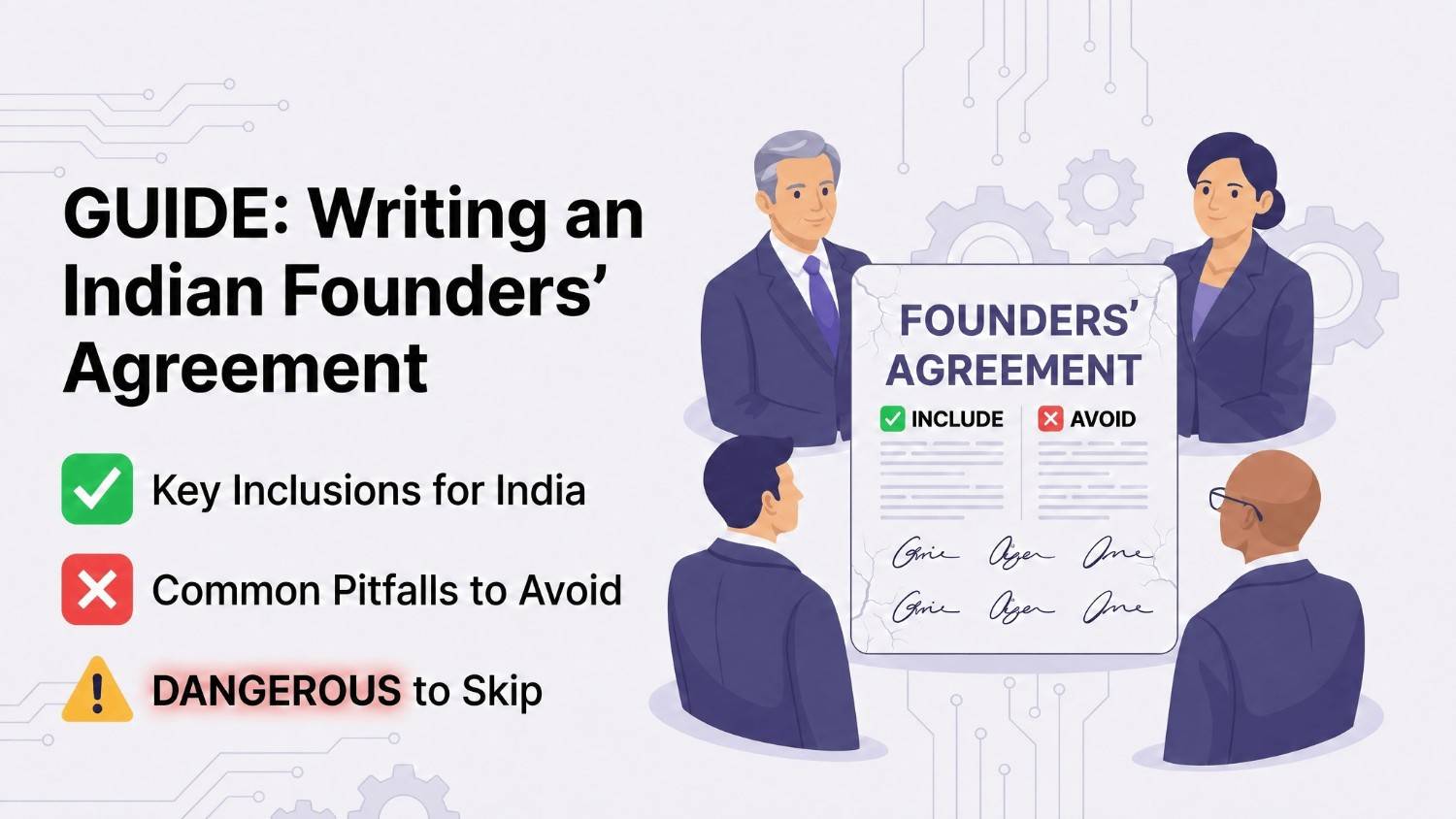
Table of Contents
- 1. The Story Nobody Wants to Tell
- 2. What Is a Founders Agreement
- 3. Why Most Startups Skip It and Why That Is Dangerous
- 4. What to Include in a Founders Agreement
- 5. What to Avoid in a Founders Agreement
- 6. Founders Agreement vs Shareholders Agreement
- 7. How to Actually Draft One
- 8. How StartupIndia.info Can Help
- 9. Frequently Asked Questions
The Story Nobody Wants to Tell
Imagine two friends. Call them Arjun and Priya. They met at an IIT alumni event in Bengaluru, bonded over the same problem they had both faced in their corporate jobs, and decided to build a startup together. Arjun was the technical brain. Priya had the sales relationships and the domain knowledge. It felt like the perfect partnership.
They spent three months building a prototype. They pitched to a few angel investors. One investor got excited and offered a term sheet. That is when the conversation they had been avoiding finally arrived on their doorstep. The investor asked a simple question: what percentage does each founder hold, and is there a vesting schedule?
Arjun thought the split was 60:40 in his favour because he had built the product. Priya thought it was 50:50 because they had always spoken about it that way. There was nothing in writing. There was no vesting. There was no founders agreement at all.
The investor walked away. They never did close that round. By month nine, Priya had left to take a corporate job. She still held 50 percent of the company on paper. The startup Arjun was trying to grow alone now had a cap table that no serious investor would touch.
This story is not rare.
A version of this plays out in hundreds of Indian startups every year. A founders agreement would have taken two hours to draft and could have prevented years of pain.
What Is a Founders Agreement
A founders agreement is a legal contract signed between the co-founders of a startup that governs their relationship with each other and with the company itself. It sets the rules of engagement before money, stress, and disagreement enter the picture.
Think of it as a prenuptial agreement for your startup. Nobody gets married expecting a divorce, but the document exists because the world is unpredictable. A founders agreement acknowledges that humans and businesses change over time, and it creates a framework for handling that change without destroying the company in the process.
In India, this document is governed by the Indian Contract Act, 1872, and it is fully enforceable in court. It is not a government registration or a regulatory requirement. It is a private agreement between founding team members that protects everyone involved, including the company itself.
A founders agreement is typically signed either before the company is incorporated or on the same day as incorporation. The earlier you sign it, the cleaner and more honest the conversation will be, because there is nothing yet at stake to fight over.
Why Most Startups Skip It and Why That Is Dangerous
Here is what most founding teams tell themselves in the early days. "We trust each other completely." "We will sort this out later when we have traction." "We do not need lawyers at this stage, we are bootstrapping." "A formal agreement feels like we do not believe in each other."
These are all understandable feelings. But none of them stand up once real money, real pressure, or a real co-founder exit arrives. The reason most startups skip the founders agreement is not malice. It is discomfort. Nobody wants to have the hard conversation about what happens if things go wrong when everything still feels exciting and new.
But that discomfort is precisely why the document needs to exist. Here is what is actually at stake when you do not have one.
Mistake 1
A departed co-founder owns equity forever
Without a vesting schedule in a founders agreement, a co-founder who leaves after six months keeps 100 percent of their equity. You continue building the company. They continue collecting the reward. No investor will touch a cap table with a ghost co-founder holding a large stake.
Mistake 2
Deadlock with no resolution mechanism
Two founders with equal equity and no decision-making framework means every major disagreement becomes a stalemate. Without a agreed process for resolving deadlocks, the business simply stops moving.
Mistake 3
IP built before incorporation belongs to the founder personally
If you spent a year building your product before formally incorporating the company, that intellectual property belongs to you as an individual, not to the company. Without an IP assignment clause in the founders agreement, your company technically owns nothing it was built on.
Mistake 4
A departing founder can immediately work for or start a competitor
Without a non-compete clause, a co-founder who leaves can start a competing business the very next day, taking with them everything they learned about your customers, technology, and strategy.
Mistake 5
Investor due diligence fails
Every serious investor in India runs due diligence on legal documents before closing a round. The absence of a founders agreement, combined with unclear equity and vesting, is one of the most common reasons deals collapse at the term sheet stage.
What to Include in a Founders Agreement
A well-drafted founders agreement does not need to be a hundred-page legal document. What it does need is clarity on the seven areas below. Each one addresses a different way that co-founder relationships break down.
Equity Split and Vesting Schedule
The equity split is the single most contentious conversation in any founding team, which is exactly why it needs to be written down clearly and agreed upon early. Equal splits are common but not always appropriate. Whoever had the original idea, who is taking a salary cut, who built the MVP, who is bringing in the first customers, all of these factors should inform the split.
But the split alone is not enough. What matters equally is the vesting schedule. Vesting means that a co-founder earns their equity over time by staying with the company and contributing to it. The standard in the Indian startup ecosystem is a four-year vesting period with a one-year cliff.
What does a 4-year vest with 1-year cliff mean?
A one-year cliff means that if a co-founder leaves before completing one full year, they earn zero equity. After the cliff, the remaining shares vest monthly or quarterly over the next three years. This protects the company from someone walking away after three months with a permanent 30 percent stake.
The founders agreement should also address what happens to unvested equity when a co-founder leaves. Does it go back to the company pool? Does the remaining founder have the right to buy it at a pre-agreed price? These provisions protect the cap table and keep it clean for investors.
Roles and Responsibilities
Write down who is responsible for what. Not in vague terms like "Arjun handles tech and Priya handles sales" but in specific terms that include decision-making authority within each domain. Who can hire someone? Who can sign a vendor contract below a certain value? Who can commit the company to a partnership?
This section also needs to address how the roles will evolve as the company grows. What happens when you hire a CTO? Does the technical co-founder remain in a product role or does their scope change? Having this conversation early prevents resentment later when growth forces structural changes.
Decision Making Authority
Separate decision-making into tiers. Routine operational decisions can be made by any individual founder within their domain. Strategic decisions, like entering a new market, raising funding, or hiring for a senior role, should require agreement from all co-founders. Major decisions, like selling the company or taking on debt, should require a formal board resolution.
Most importantly, define what happens when co-founders cannot agree. A common mechanism is a deadlock provision that gives the founder with majority equity a casting vote after a cooling-off period, or that allows either party to trigger a buyout process if a deadlock persists for more than thirty days.
Intellectual Property Ownership
This is the clause that shocks most first-time founders when they realise it needs to exist. If any founder wrote code, designed a product, created a process, or developed any other intellectual work before or during the company, that IP needs to be formally assigned to the company.
Without this assignment, the company is built on IP it does not legally own. During fundraising, investor lawyers will ask for proof of IP ownership and the absence of this clause will either delay or kill the deal. This applies even if you are the sole founder who built everything yourself.
The IP assignment clause should cover not just what has already been built but also anything the founders create in the future that is related to the company's business. This prevents a founder from later claiming that a particular piece of work belongs to them personally.
Exit Provisions and Buyout Rights
This section deals with the scenarios nobody wants to think about when they are starting up. What happens if a co-founder wants to leave? What if they are asked to leave? What if someone receives an external job offer they cannot refuse?
A good founders agreement includes a buyout mechanism that allows the remaining founder or the company to purchase the departing founder's unvested shares at a formula-based price. This should also cover good leaver and bad leaver distinctions. A founder who leaves voluntarily is a good leaver. A founder who is removed for misconduct is a bad leaver. The two scenarios should attract different buyout terms.
The agreement should also address what happens in a transfer scenario. If a founder wants to sell their shares to a third party, the remaining founders should have a right of first refusal. This prevents a stranger from suddenly owning 30 percent of your company because one founder sold their stake without telling anyone.
Non-Compete and Confidentiality
A non-compete clause restricts a departing co-founder from working with or starting a company that directly competes with your business for a defined period after leaving. In India, overly broad non-compete clauses may be struck down by courts as being in restraint of trade under Section 27 of the Indian Contract Act. Keep the restriction reasonable: twelve to twenty-four months, limited to the specific industry and geography where you actually operate.
The confidentiality clause is equally important and easier to enforce. It restricts all founders from sharing sensitive business information including customer data, financial projections, product roadmaps, and investor terms with anyone outside the company without authorisation.
Dispute Resolution
Litigation in India is slow and expensive. Most founders agreements include an arbitration clause under the Arbitration and Conciliation Act, 1996. Arbitration allows disputes to be resolved faster, in private, and with more flexibility than court proceedings. Specify the seat of arbitration, the number of arbitrators, and the language in which the proceedings will be conducted.
Also include the governing law and jurisdiction. For a Mumbai-based company, this would typically be "This agreement shall be governed by and construed in accordance with the laws of India. The parties submit to the exclusive jurisdiction of the courts of Mumbai."
What to Avoid in a Founders Agreement
Knowing what to leave out is as important as knowing what to include. Here are the most common mistakes founders make when drafting this document.
Vague language about roles
No clause for the single-founder scenario
Copy-pasting foreign templates
Ignoring the shareholder agreement relationship
Signing without independent advice
Founders Agreement vs Shareholders Agreement
These two documents are often confused but they serve different purposes and apply at different stages of the company's life.
| Aspect | Founders Agreement | Shareholders Agreement |
|---|---|---|
| When signed | Before or at incorporation | After funding or when investors join |
| Who signs | Founding team only | All shareholders including investors |
| Primary focus | Founder relationship and conduct | Governance, rights, and investor protections |
| Includes vesting | Yes, typically | Sometimes, as a reference |
| IP assignment | Yes, explicitly | May reference founders agreement |
| Legally registered | No, private document | No, but filed with company records |
The founders agreement is the document you need right now, before the company is formally alive. The shareholders agreement comes later, typically when a Series A or angel round is closing. Both are necessary. Neither replaces the other.
How to Actually Draft One
Here is the honest answer. You should not draft a founders agreement by yourself using a generic template from the internet. The document needs to reflect the specific structure of your company, the specific roles of your founders, and the specific laws that apply to your business in India. A template gives you a starting point but it is not a finished product.
The process typically looks like this. First, have an open conversation with your co-founders about all the hard questions: equity, roles, vesting, what happens if someone wants to leave, what happens if the company fails. Do this before engaging a professional so that you arrive with a shared understanding of what you want the document to say.
Second, engage a CA firm or legal advisor with experience in startup structuring in India. They will translate your agreed terms into legally precise language that will hold up under scrutiny. This is not an area where you want to cut costs. The cost of getting this right is a fraction of the cost of getting it wrong.
Third, sign the document before you incorporate the company or on the same day. Print it on appropriate stamp paper for your state. Have it witnessed. Store signed copies securely and digitally.
Fourth, review it once a year or whenever there is a major change in the founding team, equity structure, or business model. A founders agreement is a living document, not a one-time formality.
Timing matters more than most founders realise.
The best time to sign a founders agreement is when nobody needs anything from anyone else yet. The moment there is funding interest, a major customer, or a product milestone on the horizon, the negotiation becomes harder because every clause now has real stakes attached to it.
How StartupIndia.info Can Help
At StartupIndia.info, powered by MGA Group, we work with founding teams at exactly this stage: before the legal paperwork piles up and before a single conflict arises. We help you structure the founders agreement in a way that protects the company, respects all founders, and satisfies investor expectations during due diligence.
Our advisory team has helped startups across industries get their foundational documents right, from the founders agreement through to company incorporation, DPIIT recognition, and fundraising readiness. We do not use templates. We build documents that reflect the actual structure of your business.
If you are at the stage of incorporating your company and need guidance on structuring a founders agreement alongside the registration process, our team is ready to help. You can also reach out if you have already incorporated but never signed a founders agreement and want to understand your options for putting one in place retroactively.
Get Your Founders Agreement Right
Our team will help you draft, review, and finalise a founders agreement that protects all parties and keeps your cap table clean for investors.
You can also explore our guide on how to register a startup in India and our resource on share allotment and transfers to understand the full legal landscape your company will operate in from day one.
If you have questions or want to discuss your specific situation before committing to anything, reach out to us directly. A fifteen-minute conversation with our team can save months of legal trouble down the road.
Frequently Asked Questions
Is a founders agreement legally binding in India?
Yes. A founders agreement is a legally binding contract under the Indian Contract Act, 1872, provided it meets the standard requirements of a valid contract: offer, acceptance, consideration, capacity, and lawful purpose. It is fully enforceable in Indian courts and in arbitration proceedings.
When should founders sign a founders agreement?
Ideally before the company is incorporated or at the very latest on the day of incorporation. The longer you wait, the harder it becomes to agree on terms when there is real equity and real money at stake. Conversations that take two hours before incorporation can take two months after a funding round.
Is a founders agreement the same as a shareholders agreement?
Not exactly. A founders agreement is signed before or during incorporation and governs the relationship between founding team members. A shareholders agreement is a formal corporate document signed after incorporation that governs all shareholders, including investors. The two often overlap but serve different stages of the company.
Can a founders agreement be amended later?
Yes. Any amendment requires the written consent of all parties who originally signed the agreement. It is good practice to review and update the document when the team structure, equity, or business model changes significantly. Keep a version history and store all signed copies securely.
What happens if there is no founders agreement and a co-founder leaves?
Without a founders agreement, a departing co-founder retains whatever equity they hold regardless of how much or how little they contributed before leaving. This means your cap table carries dead weight that no serious investor will overlook. Rectifying this retroactively requires negotiation and legal work that is far more expensive than drafting the agreement properly at the start.
Does a founders agreement need to be notarized in India?
Notarization is not mandatory for a founders agreement in India. However, executing it on stamp paper of the appropriate value for your state and having it witnessed adds evidentiary weight if a dispute ever reaches arbitration or court. Your CA or advisor will guide you on the correct stamp duty value for your state.
Can I use a free online template for a founders agreement?
You can use a template as a starting point for your internal discussion, but generic templates rarely account for the specific structure, jurisdiction, IP ownership rules, or vesting needs of your company. A qualified CA or legal advisor should review and customise any template before it is signed. The cost of professional review is far less than the cost of a dispute arising from a poorly drafted clause.
Ready to structure your startup the right way?
From founders agreements to company incorporation and DPIIT recognition, our team handles everything so you can focus on building your product.
Talk to Our Experts