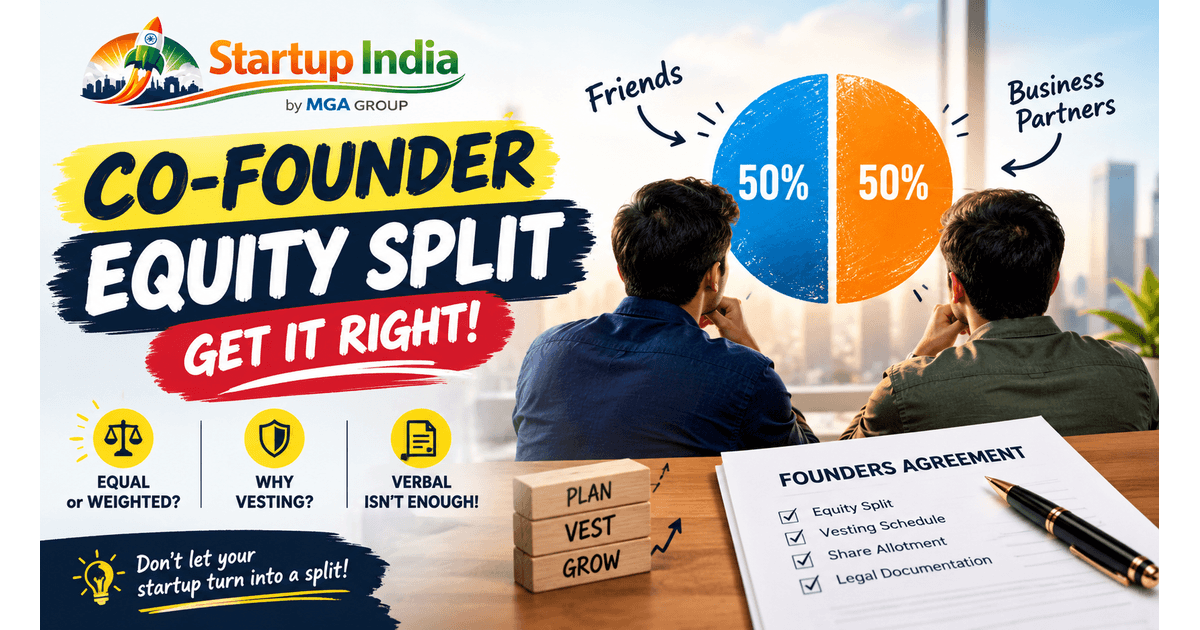
Most co-founder breakups aren't about the product failing - they're about an equity conversation that never properly happened. Two friends split 50/50 over a coffee, never wrote down what happens if one of them leaves, and eighteen months later one of them is gone while still owning half the company. Here is how to actually get this right.
4 yrs
Standard founder vesting period
1 yr
Typical cliff before any equity vests
#1
Reason cap tables get messy: no vesting
0%
Equity a founder keeps leaving before cliff
Why Equity Splits Break Founder Relationships
Founders are usually great at agreeing on the big things - the product, the market, the mission - and terrible at having the equity conversation early. It feels transactional to negotiate ownership with someone you are about to spend years building a company with, so most founders skip it, default to an even split, and move on to building.
That works fine until a co-founder loses motivation and drifts away after eight months, or one realizes they are doing three times the work for the same slice of the pie. This is the single most common reason early startups collapse before they ever raise real money, and it is almost entirely preventable with two documents: a proper vesting schedule and a founders' agreement that spells out what happens when things change.
This guide walks through how to actually structure a fair, durable equity split - and just as importantly, how to document it so it survives a disagreement instead of causing one.
Equal Split vs Contribution-Based Split
The first real decision is whether to split equity equally or weight it by contribution. Both can work - the mistake is picking one without actually thinking through which situation you are in.
| Approach | When It Actually Works |
|---|---|
| Equal split (e.g. 50/50, 33/33/33) | Founders joining at the same time, with comparable skills, time commitment, and no significant prior capital or IP contributed by any one person |
| Contribution-weighted split | One founder originated the idea, built an early prototype, invested personal capital, or is joining full-time while others stay part-time - differences that an equal split would ignore |
| Dynamic / "slicing pie" split | Very early-stage teams where roles and contributions are still evolving and founders want the split to adjust based on actual contribution over the first several months |
The Founder Vesting Schedule Every Team Should Use
Vesting is the single biggest protection against a bad equity split. Instead of handing over 100% of a founder's shares on day one, vesting releases that equity gradually as the founder actually stays and contributes - so if someone leaves early, they leave with only what they earned.
- 1Set a total vesting period - four years is the widely used standard, matching what investors and employees are typically offered later
- 2Build in a one-year cliff - no equity vests at all until the founder completes a full year, after which a large chunk (commonly 25%) vests at once
- 3Vest the remaining equity monthly or quarterly after the cliff, so ongoing commitment continues to be rewarded gradually
- 4Decide how much prior contribution (an existing prototype, IP, or capital already invested) should count as pre-vested equity, and document that decision explicitly
- 5Include acceleration terms for specific events, such as a full or partial vesting acceleration if the company is acquired
- 6Put all of this in writing as part of the founders' agreement and reflect it in the actual share allotment records, not just a side conversation
Common Equity Split Models
Equal Split
Simple, fast to agree on, and works well when founders joined together with comparable time and skill commitment. Weakest when contributions diverge later.
Contribution-Weighted Split
Assigns a higher percentage to founders who brought the original idea, early capital, or full-time commitment from day one. Requires an honest, sometimes uncomfortable conversation upfront.
Dynamic (Slicing Pie) Split
Equity percentages adjust based on ongoing, tracked contributions (time, cash, resources) rather than being fixed at the start - useful for very early, fluid teams.
Investor-Standard Vesting Overlay
Whatever split you choose, applying a four-year vesting schedule with a one-year cliff on top of it is what most investors will expect to already be in place.
Whichever model you land on, it becomes far easier to sell to investors now that angel tax no longer taxes a fair equity round as if it were undisclosed income.
What Belongs in a Founders' Agreement Equity Clause
A verbal understanding of who owns what is not a legal protection - it is a recollection that two people can later remember differently, and the Companies Act, 2013 itself does not care what founders verbally agreed. The equity terms need to live inside an actual written agreement, covering at minimum:
- The exact equity percentage or number of shares allotted to each founder
- The full vesting schedule, cliff period, and vesting start date for each founder
- What happens to unvested equity if a founder leaves, is removed, or passes away
- Whether departing founders are bought out, and at what valuation or formula
- Decision-making rights and what requires unanimous versus majority founder consent
- How future dilution from new hires, advisors, or investors will be shared
Documenting the Split Legally in India
A founders' agreement establishes intent, but it does not by itself create legal ownership. For a Private Limited Company, share ownership becomes legally binding only once shares are actually allotted through the proper incorporation process - a board resolution, a PAS-3 filing with the Registrar of Companies, and issuance of share certificates.
This is where founders most often create accidental problems: agreeing verbally on a 70/30 split, then allotting shares 50/50 out of convenience or an unadjusted template. Records reflect what was actually allotted, not what was intended, so the paperwork has to match the agreement exactly from the first allotment. Our share allotment guide walks through the PAS-3 filing process, SH-4 transfer deeds, and valuation requirements in full detail.
Handling a Co-Founder Who Leaves Early
This is the scenario every founder should plan for before it happens, precisely because it is so common. Without vesting, a co-founder who leaves after four months keeps their entire original equity stake indefinitely - commonly called dead equity - while contributing nothing further to the company.
Reverse Vesting for Existing Founders
If your company is already incorporated and shares are already allotted without vesting, you are not out of options. Reverse vesting lets founders who already hold their full shares agree to make those shares subject to a buyback right if they leave before a set period - effectively applying vesting protection retroactively, with everyone's written consent.
Equity and Fundraising - How Investors View Your Cap Table
By the time you are raising outside capital, your cap table is one of the first things a serious investor reviews. A clean, well-documented split with proper vesting signals discipline; a messy one - undocumented allotments, an unexplained imbalance, or a departed co-founder still holding a large unvested stake - raises questions before the investor has even asked about your product. If you are preparing to raise, it is worth reading our pitch deck guide, since your cap table and founder story are usually reviewed together during diligence, not treated as separate conversations.
Common Mistakes Founders Make With Equity Splits
Beyond the split itself, keeping ROC filings updated whenever ownership changes is where the paperwork most often lags behind reality.
Mistake 1
Defaulting to an even split to avoid a hard conversation
An equal split chosen out of discomfort rather than genuine agreement tends to resurface as resentment once contributions visibly diverge.
Mistake 2
Skipping vesting entirely
Handing over full equity on day one leaves the company exposed to dead equity if any founder leaves early, with no way to recover that stake.
Mistake 3
Agreeing verbally and never documenting it
A verbal split has no legal weight. Without a written founders' agreement and matching share allotment records, there is nothing to enforce if a disagreement happens.
Mistake 4
Letting share allotment paperwork drift from the actual agreement
Filing shares 50/50 by default when the real agreement was 70/30 creates a legal record that contradicts what founders actually intended.
Mistake 5
Never revisiting the split as roles change
A split fair at incorporation can become unfair a year later if one founder's role and contribution have grown significantly more than agreed - address this explicitly rather than letting it go unspoken.
Which Model Fits Your Situation?
Whatever you pick now, remember that transferring or buying back equity later can trigger capital gains tax under Indian income tax law, so the cheaper structure today is not always the cheaper one over the company's life.
| Your Situation | Recommended Approach |
|---|---|
| Founders joining together, equal time and skills | Equal split with standard 4-year / 1-year cliff vesting |
| One founder brought the idea, prototype, or capital | Contribution-weighted split, still fully vested |
| Team still forming, contributions unclear | Dynamic (slicing pie) split, formalized once roles stabilize |
| Already incorporated without vesting | Reverse vesting agreement signed by all founders |
| Preparing to raise outside funding | Clean, documented split plus investor-standard vesting overlay |
Equity split decisions rarely happen in isolation - they usually surface again whenever a team revisits funding options for Indian startups and has to decide how much further dilution the existing split can absorb.
How StartupIndia.info Can Help
Getting the conversation right is only half the work - the split also has to be documented correctly and reflected in your company's legal records. As part of MGA Group, our team handles both sides.
| What You Need | How We Help | Link |
|---|---|---|
| Founders' Agreement & Vesting Terms | Drafting equity, vesting, and departure clauses that hold up legally | Get Started → |
| Share Allotment & Cap Table Filing | PAS-3 filings, SH-4 transfer deeds, statutory record-keeping | Learn More → |
| Private Limited Company Registration | Correct entity setup before allotting founder shares | Register Now → |
| Pitch Deck & Funding Readiness | Clean up your cap table story before investor conversations | Get Started → |
| Startup Consultation | Advisory session to map your equity split and documentation | Book a Call → |
Frequently Asked Questions (FAQs)
Q1. What is the fairest way to split equity between co-founders?
Q2. What is a vesting cliff and why does every founder need one?
Q3. Should founders use the same vesting schedule as employees get?
Q4. What happens if a co-founder wants to leave after six months?
Q5. Can an equity split be changed after the company is incorporated?
Q6. Does a verbal agreement on equity split hold up legally in India?
Q7. How does equity split affect fundraising later?
Q8. Can StartupIndia.info help structure our founder equity split?
Ready to Structure Your Founder Equity Split?
The best time to have this conversation is before it feels necessary - while everyone is still aligned and nothing is at stake yet. Get the split, the vesting schedule, and the paperwork right once, and it stops being a source of tension for the rest of the company's life.
Need help structuring your co-founder equity split?
Our consultants help founding teams agree on a fair split, set up proper vesting, and get the share allotment paperwork filed correctly from day one.
Book a Startup Consultation