Every founder has felt it at 2 a.m.: the idea feels obviously right in your head, but you have no real proof anyone outside your head agrees. Product-market fit isn't a feeling - it's a set of signals you can actually go and check before you spend a single rupee building.
40%
Sean Ellis test threshold for strong fit
15-20
Customer conversations to spot a pattern
1
Variable to change per pivot
0
Rupees needed for a fake-door test
What Product-Market Fit Really Means
Product-market fit is the point where a specific group of people wants what you're building badly enough that growth stops feeling like a fight. Demand starts pulling the business forward instead of you pushing it uphill every single day.
That definition is useful but vague enough to fool people. Founders often mistake early politeness - friends saying “cool idea,” strangers offering a mild “I'd probably use that” - for actual fit. Real fit shows up in behaviour, not compliments. Before you commit months to building, it helps to read our guide on startup funding, since the route you raise money through later depends heavily on how much real proof you can already show.
Why Most Startups Fail Here, Not on Execution
Post-mortems on failed startups consistently point to the same root cause: there simply wasn't enough real market need. Not a broken product. Not a weak team. Not underfunding. The market itself was thinner than the founders believed when they started building.
A well-built product for a problem nobody urgently has will still fail, and a rough, ugly product for a real, painful problem can still take off. Research communities built around startup outcomes, including Y Combinator, have repeated a version of this finding across thousands of companies: the startups that struggle most are usually the ones that skipped talking to real customers before they started building.
The Fake Signals That Feel Like PMF But Aren't
Before looking at what real fit looks like, it helps to rule out the signals that feel encouraging but mean almost nothing on their own.
- Friends and family telling you the idea is “great” - they are rooting for you, not evaluating a purchase
- People saying “I'd definitely use that” without ever opening their wallet
- A social media post about your idea getting likes and encouraging comments
- Survey respondents rating your concept highly, with no money or commitment attached
- A large waitlist that never converts into paying users once you launch
This is also the stage where founders sometimes rush into registering a company before the idea itself has been confirmed, which just adds compliance overhead to an unproven business.
The Three Real Signals of Product-Market Fit
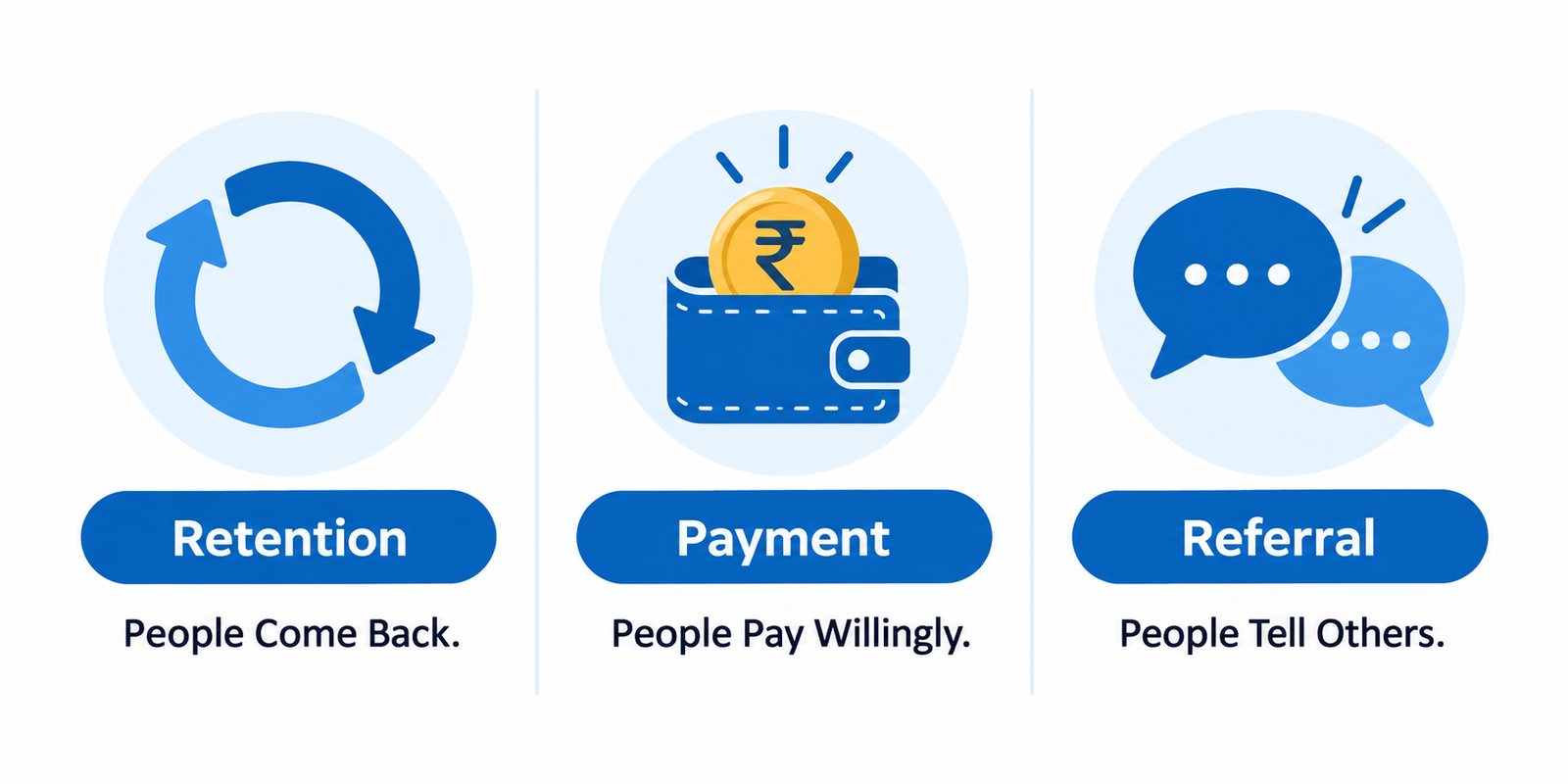
Ignore the noise and watch these instead. They are harder to fake, because they show up in what people actually do rather than what they say.
People Come Back
Retention is the clearest proof of real value. If someone uses your product once and never returns, the problem wasn't painful enough or the solution wasn't good enough - usually both.
People Pay Willingly
Money is the most honest signal a founder can get. A free trial that converts, or a pre-order that clears, tells you far more than any survey ever will.
People Tell Others
Organic referral means the value is real enough that someone spends their own social capital recommending you, unprompted.
Growth Gets Easier
When fit is real, each new customer gets a little cheaper and faster to acquire, because word of mouth and repeat use start doing part of the work for you.
Once payment becomes real rather than hypothetical, GST registration and proper invoicing stop being optional and start being a compliance deadline.
The Sean Ellis 40% Test
One of the most widely used PMF checks in the startup world is a single survey question, popularised by growth researcher Sean Ellis: ask existing users how they would feel if they could no longer use your product.
The number itself matters less than the discipline behind it: ask real users a direct question, and let their honest answer, not your hope, decide what happens next. Research from McKinsey on early-stage ventures echoes the same point: teams that validate with structured questions outperform teams relying on internal conviction alone.
How to Validate Demand Before You Build Anything
You don't need a finished product to start collecting real signal. This sequence works for most early-stage ideas.
- 1Write down the exact problem in one sentence, naming a specific type of person, not 'everyone'
- 2Talk to 15-20 people who actually have the problem, asking about current behaviour and past spending, not opinions
- 3Build the smallest possible test - a landing page, a simple form, or a manual concierge version of the service
- 4Ask for something real - a pre-order, a deposit, or a waitlist that requires a card to hold a spot
- 5Measure behaviour, not opinions - track who actually converts, returns, or refers someone else
If you already have a co-founder in the mix, this is also the right moment to settle how you'll split ownership - our guide on equity split covers exactly that conversation before real money and real stakes make it harder.
The Fake-Door Landing Page Test
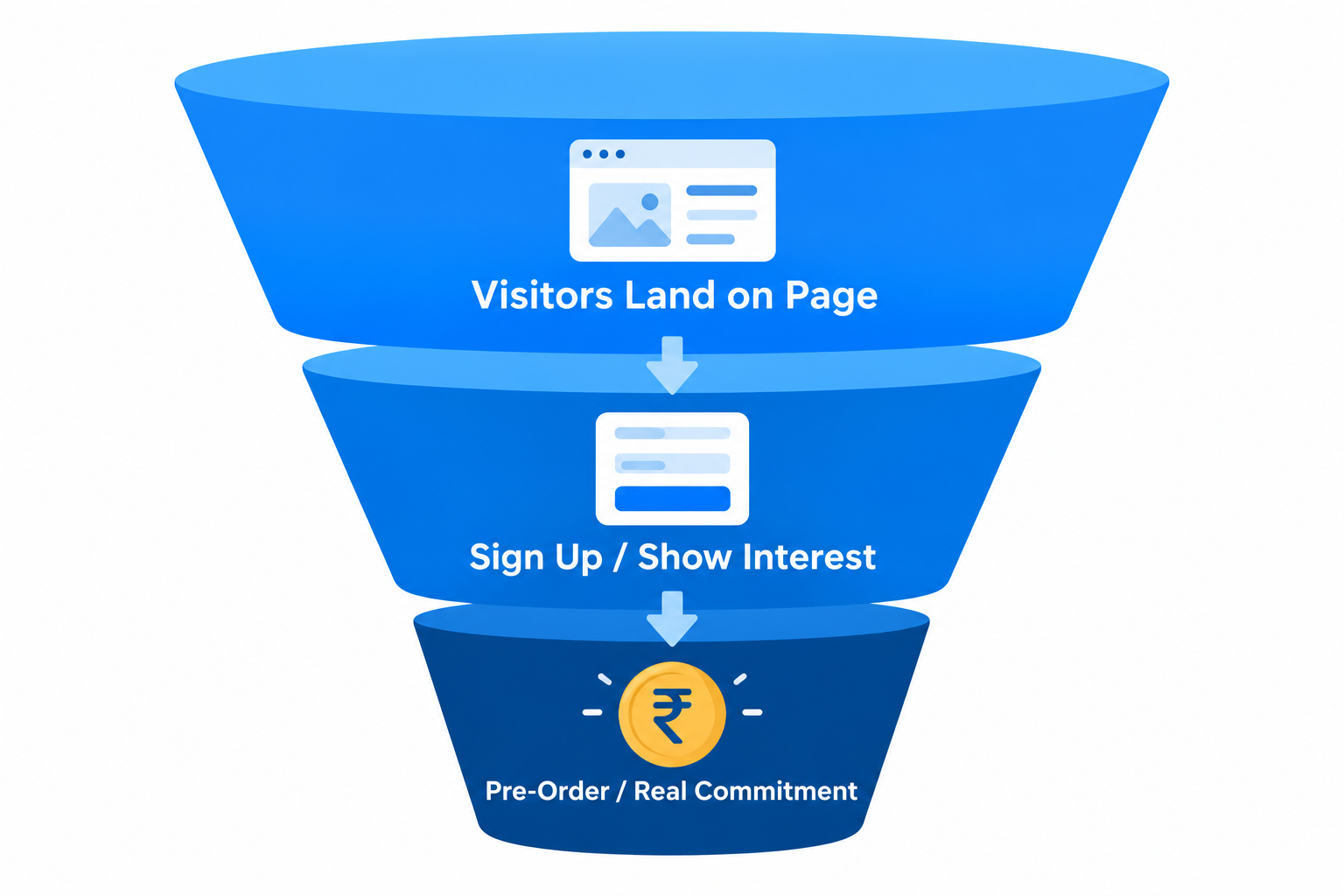
One of the cheapest ways to test demand is a “fake door”: a simple, honest landing page describing the offer, with a real way to sign up or pre-order, built before the product exists. Traffic sent to that page tells you whether the idea earns attention and commitment on its own.
| Approach | What It Actually Proves |
|---|---|
| Building the full product first | Whether you can build something - not whether anyone wants it |
| Fake-door landing page + real traffic | Whether strangers with no loyalty to you will act on the offer |
| Asking friends for opinions | Whether people who like you are willing to be encouraging |
A well-built landing page tested with a small amount of real traffic gives a founder more honest signal in a week than months of internal debate ever will.
Using Search Signals to Confirm Demand
Before spending on ads, check whether people are already searching for a solution to the problem you're solving. Google Trends shows whether interest in a problem is rising, flat, or shrinking over time - a free, honest starting point before you spend a rupee on testing.
Search behaviour and buying behaviour aren't identical, but a category nobody is searching for is a harder sell than one with steady, existing demand. Investors at firms like a16z often describe the strongest early companies as ones riding a demand wave that already existed, rather than ones trying to create demand out of nothing.
When to Pivot vs When to Persevere
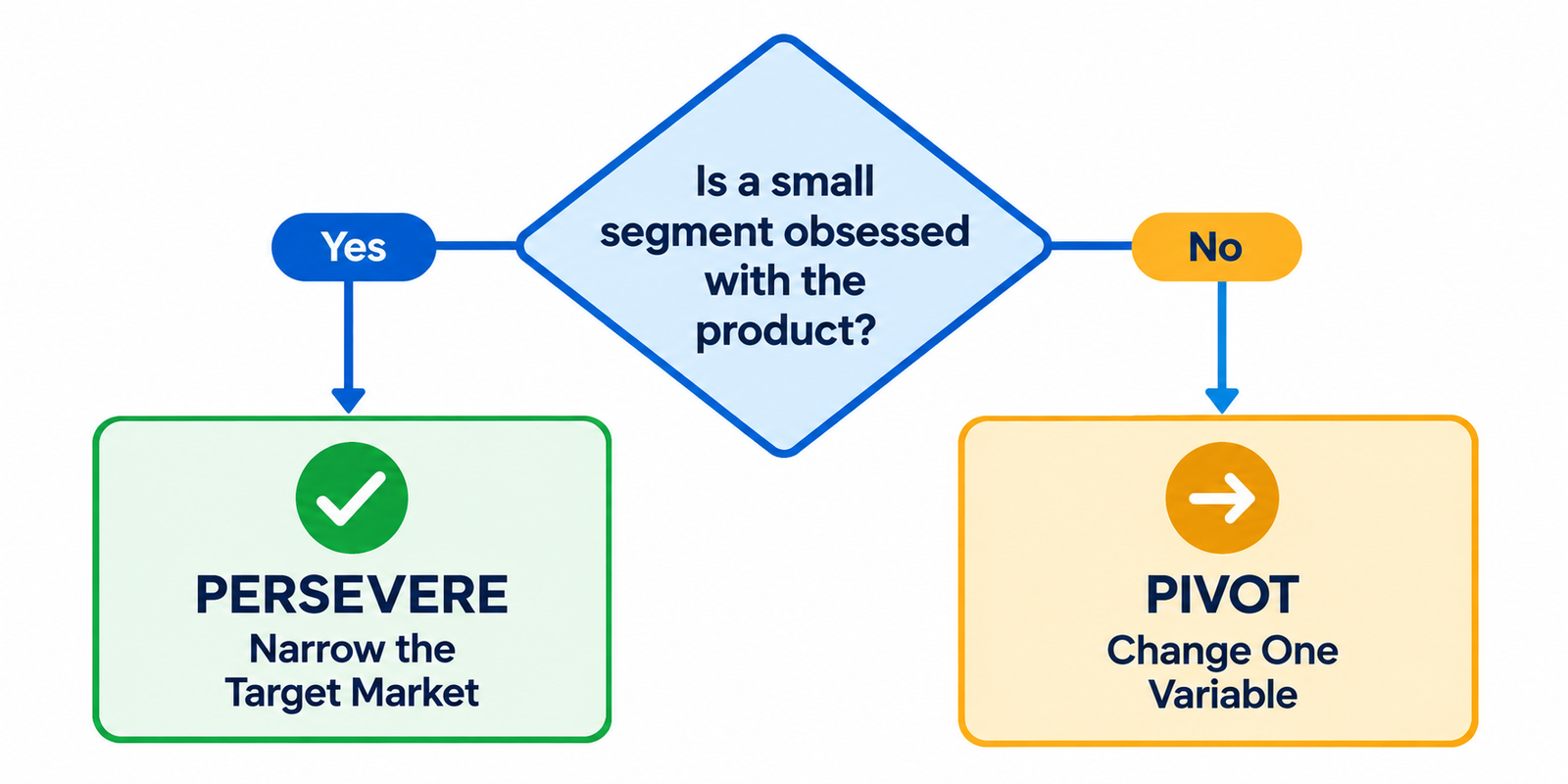
Weak early signal doesn't always mean the idea is dead. Sometimes it means one piece of the equation is wrong while the rest is worth keeping.
A useful gut check, discussed at length in research from HBR: if a small, specific segment of your early users loves the product intensely even while the broader audience shrugs, that's usually a sign to narrow the target market, not abandon the idea entirely.
If a pivot changes who owns what in the business, it is worth revisiting your share allotment records before the paperwork falls further behind reality.
Common Mistakes Founders Make While Chasing PMF
Mistake 1
Treating a big waitlist as proof
Waitlists cost nothing to join and convert poorly without real commitment attached.
Mistake 2
Testing with friends and family instead of strangers
People who like you have no reason to be honest about whether they'd actually pay.
Mistake 3
Building for months before running a single real test
Six months of development produces an opinion, not evidence, if no real money or commitment was ever involved.
Mistake 4
Changing three variables in one 'pivot'
Changing the audience, the offer, and the pricing at once makes it impossible to know what actually fixed anything.
Mistake 5
Confusing a vocal minority with real market size
A handful of enthusiastic users can feel like momentum while the addressable market stays too small to build a company on.
Once you have real signal, it also becomes the strongest slide in your deck. Our pitch deck guide covers exactly how investors expect that traction to be presented.
What Changes Once You Have Real Signal
Validation isn't the finish line, but it does change what comes next. Real paying users mean you need proper invoicing and a registered entity sooner than you think, and DPIIT recognition becomes worth applying for once you can show genuine traction rather than just an idea.
This is also the point where founders who moved fast and loose on structure start paying for it - an undocumented founders' agreement becomes a much bigger problem once there's actual revenue worth arguing about.
How StartupIndia.info Can Help
Validating an idea is a business decision as much as a product one. As part of MGA Group, our team helps founders get the structure right once real signal starts to appear.
| What You Need | How We Help | Link |
|---|---|---|
| Business Model Structuring | Turn early validation signal into a workable business model and pricing plan | Get Started → |
| Pitch Deck & Funding Readiness | Package your traction into a deck investors actually respond to | Learn More → |
| Private Limited Company Registration | Register the right entity once you're ready to accept real payments | Register Now → |
| DPIIT Startup Recognition | Apply once you have genuine traction to show, not just an idea | Apply Now → |
| Startup Consultation | Advisory session to map your validation plan and next steps | Book a Call → |
Frequently Asked Questions (FAQs)
Q1. How do I know if my startup idea has product-market fit?
Q2. Can I test product-market fit before building the actual product?
Q3. What is the Sean Ellis 40% test?
Q4. Is a large waitlist a sign of product-market fit?
Q5. How many customer interviews do I need before building?
Q6. What is the difference between pivoting and giving up?
Q7. Do I need to register a company before testing product-market fit?
Q8. Can StartupIndia.info help me validate an idea before I build it?
The Bottom Line
Product-market fit isn't found in a brainstorm or a pitch deck. It's found in a landing page that converts, a survey where people say they'd be devastated to lose you, and a customer who tells a friend without being asked. Run the cheap tests first. Let real behaviour, not your own conviction, decide whether it's time to build.
Ready to test your idea properly?
Our consultants help founders structure a real validation plan and the paperwork that follows once the signal is genuine.
Book a Startup Consultation