If you have an incorporated startup in India and have not yet applied for DPIIT recognition, you are most likely leaving free tax savings, government benefits, and credibility on the table. This guide explains everything in plain language.
Table of Contents
- 1. What Is DPIIT Startup Recognition?
- 2. DPIIT Recognition vs Startup India - Are They the Same?
- 3. Who Can Apply - Eligibility Criteria
- 4. Benefits of DPIIT Recognition - Explained Simply
- 5. Documents You Need
- 6. How to Apply - Step by Step
- 7. How to Apply for the 80IAC Tax Exemption
- 8. DPIIT Recognition vs MSME Registration - Key Differences
- 9. Common Mistakes Founders Make
- 10. How StartupIndia.info Helps You
- 11. Frequently Asked Questions
What Is DPIIT Startup Recognition?
DPIIT Startup Recognition is an official certificate issued by the Department for Promotion of Industry and Internal Trade (DPIIT), which is part of the Ministry of Commerce and Industry under the Government of India.
When your startup gets this certificate, it is officially recognized as a Startup under India's Startup India scheme. This is not just a badge of honour. It unlocks a set of real, tangible benefits - from tax holidays and investor protection to priority IP filing and government contract access.
Think of it as the government saying: “We recognize you as an innovative startup. Here are your rewards.”
DPIIT Recognition vs Startup India - Are They the Same?
Yes, they refer to the same thing. When someone says Startup India registration, they almost always mean getting DPIIT recognition via the Startup India portal at startupindia.gov.in.
The full form of the process is: Applying for recognition as a Startup under the Startup India Action Plan, managed by DPIIT.
Once you are recognized, you receive a DPIIT Recognition Number (also called DPIIT number or startup recognition certificate). This number is what you use to claim all the benefits.
Who Can Apply - Eligibility Criteria
Not every business can get DPIIT recognition. Here are the exact conditions your startup must meet:
Eligible Business Structures
Your business must be registered as one of the following:
- Private Limited Company (most common for startups)
- One Person Company (OPC)
- Limited Liability Partnership (LLP)
- Partnership Firm
Age and Turnover Limits
| Feature | Details |
|---|---|
| Maximum age of entity | Not more than 10 years from date of incorporation |
| Annual turnover limit | Must not exceed Rs 100 crore in any financial year |
Most early-stage startups easily fall within these limits. If your startup is under 10 years old and has not crossed Rs 100 crore in revenue, you likely qualify on this front.
The Innovation Requirement
This is the most important criterion. Your startup must be working towards innovation, development, improvement, or commercialization of a new product, process, or service with a scalable business model.
In simple words, DPIIT is looking for startups that:
- Solve a real problem in a new or better way
- Have the potential to grow and scale beyond a local area
- Are not just copies of existing businesses without any meaningful improvement or differentiation
There is also one more rule: your startup must not have been formed by splitting or restructuring an existing business. This rule prevents businesses from simply rebranding an existing company to claim startup benefits.
Check if Your Startup is Eligible - Apply with Our ExpertsBenefits of DPIIT Recognition - Explained Simply
This is the heart of the guide. Here is every benefit that DPIIT recognition gives you, explained in plain language:
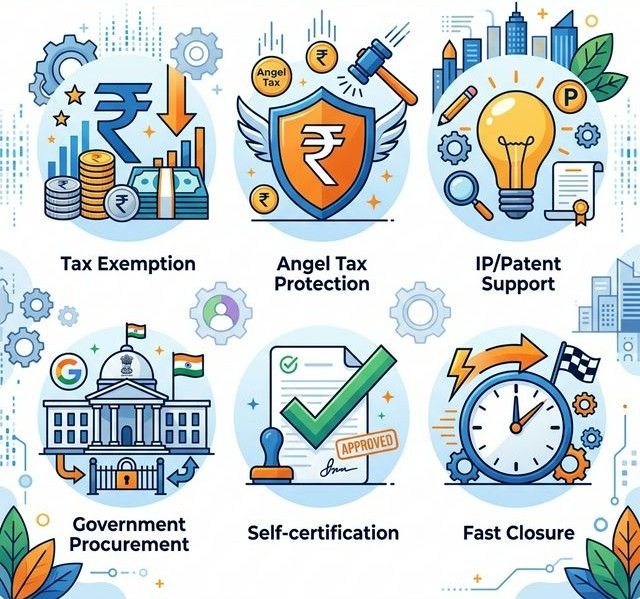
3-Year Income Tax Holiday
Pay zero income tax on your startup profits for 3 consecutive years. This can save you lakhs.
Angel Tax Protection
Investor money above fair market value will not be taxed as your income. A huge relief when raising funds.
Patent & IP at 80% Discount
Get your patents and trademarks filed at a fraction of the normal cost with dedicated government facilitators.
Government Contracts Without Experience
Bid for government tenders without needing prior turnover or experience criteria that exclude new startups.
Self-Certify Labour Compliance
Skip inspector visits for 6 labour laws and 3 environmental laws for up to 3 years.
Fast Company Closure If Needed
If the startup does not work out, you can wind down in as little as 90 days under the IBC framework.
Benefit 1 - Income Tax Holiday Under Section 80IAC
This is the biggest financial benefit of DPIIT recognition. Under Section 80IAC of the Income Tax Act, a recognized startup can claim a 100% deduction on profits for any 3 consecutive years out of its first 10 years.
What this means in real terms:
- If your startup makes Rs 50 lakhs profit in a year and you have the 80IAC exemption, you pay zero income tax on that profit
- At a 25% corporate tax rate, that is a saving of Rs 12.5 lakhs in that one year alone
- You can pick the best 3 years to apply this over your first 10 years of operation
Benefit 2 - Angel Tax Exemption (Section 56)
When a startup raises money from an investor (like an angel investor), the government sometimes taxes the amount received above the “fair market value” of the startup as income. This is what is called Angel Tax (Section 56(2)(viib)).
For example, if an investor values your startup at Rs 10 crore but the government thinks the “fair value” is only Rs 6 crore, the Rs 4 crore difference can be taxed as your income. This is a serious problem for early-stage startups where valuations are often more forward-looking than asset-based.
DPIIT-recognized startups are fully exempt from this tax. This gives you a much safer environment to raise angel and early-stage funding without worrying about a sudden tax bill on the investment itself.
Learn More About Angel Tax Exemption for Recognized StartupsBenefit 3 - Patent and Trademark Filing at 80% Discount
If you have a unique product or technology, protecting it with a patent or trademark is important. But IP filing can be expensive.
DPIIT-recognized startups get an 80% rebate on patent filing fees and access to fast-track examination. This means:
- A patent that might cost Rs 1,60,000 in fees can be filed for as little as Rs 32,000
- Government-appointed IP facilitators help you prepare and file the application at no extra cost
- Trademark applications also get a 50% fee rebate for startups
Benefit 4 - Government Procurement Without Experience Criteria
Most government tenders have a condition: you need to show proof of past work, a minimum turnover, or several years of experience to even bid. For a new startup, this automatically disqualifies you.
DPIIT-recognized startups are exempt from these prior experience and turnover requirements in central government procurement. This means you can directly compete for government contracts and supply products/services to government departments without needing years of history behind you.
Benefit 5 - Self-Certification for Labour and Environmental Laws
Running a company in India involves compliance with several labour and environmental laws. Normally, inspectors from the government can visit and audit your premises. For a small startup, this can be disruptive and stressful.
Recognized startups can self-certify compliance with 6 labour laws and 3 environmental laws for up to 3 years from the date of incorporation. No inspector visits during this period, and no random audits unless there is a specific complaint.
Learn More About Self-Certification BenefitsBenefit 6 - Fast and Simple Company Closure
Not every startup succeeds, and the government acknowledges that. If a DPIIT-recognized startup needs to wind down, the Insolvency and Bankruptcy Code (IBC) allows them to close the company in as little as 90 days.
This is much faster than the normal company dissolution process, which can take years in some cases. It allows founders to close one chapter cleanly and move to the next without being stuck in a legal limbo for years.
Documents You Need
The application process is mostly online and fairly simple. Here is what you will need:
- Certificate of Incorporation (CoI) from MCA (for Pvt Ltd, OPC) or Registration Certificate (for LLP/Partnership)
- PAN of the entity
- Details of directors/partners (name, designation, DIN)
- Brief description of the startup - what problem you solve, what makes you innovative, and your business model
- Website URL (if any)
- Pitch deck or product/service description (optional but helps speed up approval)
- A short video explaining your startup (optional)
How to Apply - Step by Step
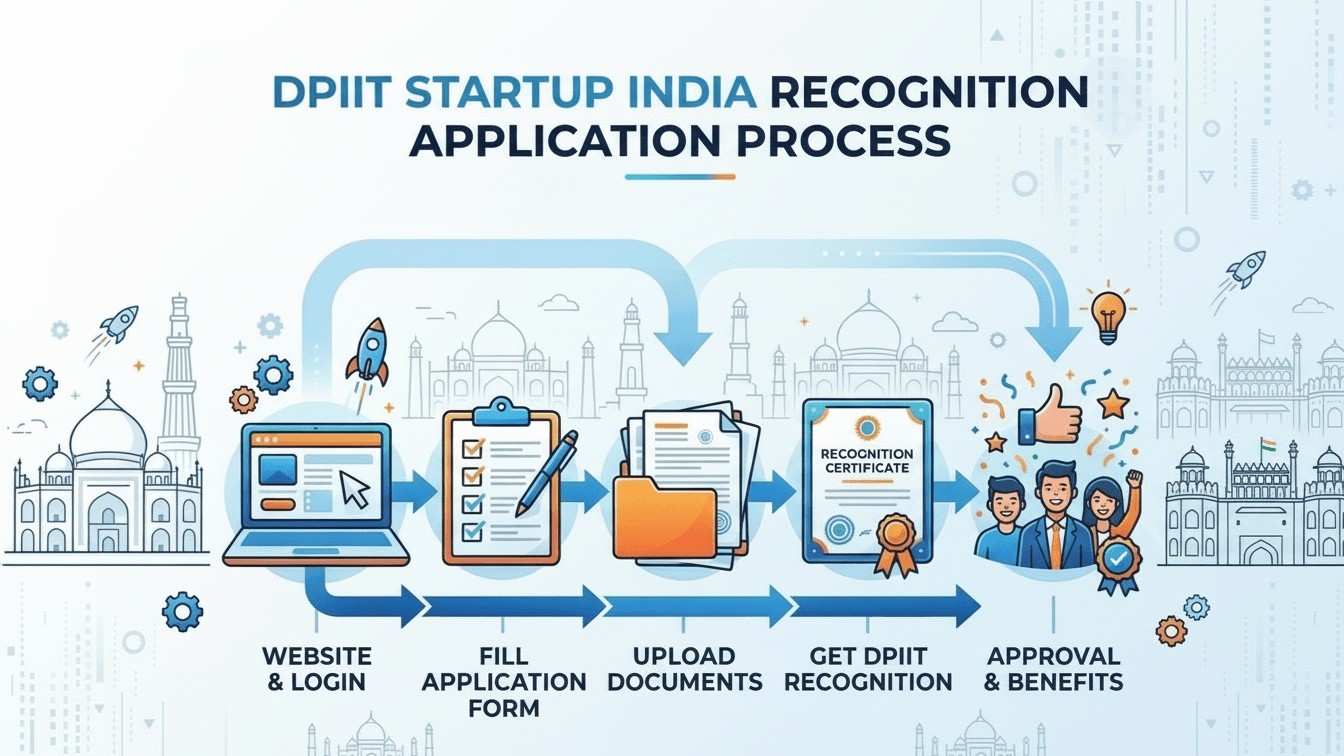
- 1Go to https://www.startupindia.gov.in and create an account using your email or Aadhaar
- 2Click on 'Get Recognized' and select your entity type (Pvt Ltd, OPC, LLP, etc.)
- 3Fill in the registration form - entity details, date of incorporation, address, director details
- 4In the 'Nature of Business' section, write a clear, honest description of your innovation and business model
- 5Upload your Certificate of Incorporation and other required documents
- 6Submit your application
- 7Receive your DPIIT Recognition Number within 2-3 working days
How to Apply for the 80IAC Tax Exemption
Getting your DPIIT recognition is step one. If you also want the income tax holiday under Section 80IAC, you need to apply separately to the Inter-Ministerial Board (IMB).
This is a more detailed review. The IMB evaluates whether your startup genuinely qualifies for the tax benefit based on innovation and scalability.
How the 80IAC Application Works:
- 1Log in to the Startup India portal after receiving your DPIIT number
- 2Apply for 80IAC tax benefit through the portal
- 3Submit additional details about your business model, traction, funding, and innovation
- 4The Inter-Ministerial Board (IMB) reviews your application
- 5If approved, you receive the 80IAC certificate which you then use when filing your ITR
DPIIT Recognition vs MSME Registration - Key Differences
Many founders confuse these two or think they are the same. They are completely separate. Here is a quick comparison:
| Factor | DPIIT Recognition | MSME / Udyam Registration |
|---|---|---|
| Issued by | DPIIT (Ministry of Commerce) | MSME Ministry (Udyam portal) |
| Eligibility focus | Innovation & scalability | Investment & turnover limits |
| Who can apply | Pvt Ltd, OPC, LLP, Partnership | Almost any business type |
| Main benefit | Tax holiday, angel tax, IP rebate | Loans, Government tenders, subsidies |
| Government fee | Free | Free |
| Can you get both? | Yes, and you should | Yes, highly recommended |
Common Mistakes Founders Make
These are the most common things we see founders get wrong when it comes to DPIIT recognition:
Mistake 1
Writing a vague innovation description
The most common reason for delays or rejections is a weak or unclear explanation of what the startup does and what makes it innovative. Be specific. Explain the problem, your solution, and why it is better.
Mistake 2
Waiting too long to apply
Some founders wait years before applying, thinking it is something to do later. The 10-year clock starts from incorporation. Every year you delay is a year off the potential window for the 80IAC tax holiday.
Mistake 3
Assuming DPIIT recognition automatically gives 80IAC
It does not. The 80IAC tax exemption requires a separate application to the Inter-Ministerial Board. Many founders only realize this when filing their taxes and miss the window.
Mistake 4
Applying as a proprietorship
Proprietorships are not eligible. Running as a proprietorship and trying to apply will get your application rejected. Incorporate as a Pvt Ltd, OPC, or LLP first.
Mistake 5
Skipping MSME registration because they have DPIIT
Both are different and both are free. There is no reason to skip MSME registration. MSME gives you access to collateral-free loans, priority banking, and government tenders that DPIIT does not cover.
Mistake 6
Not updating DPIIT portal with latest information
Your Startup India profile is public and often checked by investors and government departments. Keep it updated with correct turnover, funding, and business details.
How StartupIndia.info Helps You
Applying for DPIIT recognition sounds simple, but getting it right on the first attempt takes more care than most founders expect. A weak application can lead to delays, back-and-forth queries, or rejection. Our team at StartupIndia.info, powered by MGA Group, handles the entire process for you.
| What You Need | How We Help | Link |
|---|---|---|
| Company Registration (Pvt Ltd/OPC) | Full incorporation, DSC, DIN, PAN, TAN | Register Now → |
| DPIIT Startup India Recognition | Application drafting, portal filing, follow-up | Apply Now → |
| MSME / Udyam Registration | Udyam portal filing, certificate | Register Now → |
| 80IAC Tax Exemption | IMB application, supporting documentation | Get Help → |
| Annual Tax Compliance | ITR filing, GST returns, tax planning | Get Started → |
| Startup Consultation | Free 30-min session to plan your registration path | Book Free Call → |
Frequently Asked Questions (FAQs)
Q1. What is DPIIT Startup Recognition?
Q2. Is DPIIT recognition free to apply for?
Q3. Can a proprietorship apply for DPIIT recognition?
Q4. How long does DPIIT recognition take?
Q5. Does DPIIT recognition automatically give me the 80IAC tax holiday?
Q6. Is DPIIT recognition the same as MSME registration?
Q7. Can I get both DPIIT recognition and MSME (Udyam) registration?
Q8. What happens if my startup grows beyond the eligibility limits?
Q9. Do I need to renew DPIIT recognition?
Ready to Get Your DPIIT Recognition?
If your startup is incorporated and meets the basic criteria, there is genuinely no good reason to delay this. The process takes a few days, costs nothing in government fees, and the benefits - especially the income tax holiday and angel tax exemption - can make a meaningful difference to your business finances.
Choose where to start:
| My Situation | What I Need | Start Here |
|---|---|---|
| Already incorporated as Pvt Ltd / OPC / LLP | DPIIT Recognition | Apply for DPIIT → |
| Not yet incorporated | Company Registration First | Register Pvt Ltd → |
| Solo founder, want to incorporate | One Person Company (OPC) | Register OPC → |
| Want MSME benefits too | MSME / Udyam Registration | Register for MSME → |
| Want the 80IAC tax holiday | 80IAC Application Support | Apply for 80IAC → |
| Not sure where to start | Free Startup Consultation | Book Free Call → |
Need personalised guidance?
Our startup consultants offer a free 30-minute advisory session to help you get DPIIT recognized, plan your tax savings, and build your compliance roadmap.
Book a Free Startup Consultation