The Problem
For decades, Indian e-commerce worked for one kind of person: someone with a smartphone, a credit or debit card, a reliable internet connection, and a home address in a city that logistics companies actually delivered to.
Everyone else — the homemaker in a small town in Rajasthan, the retired government employee wanting to earn something extra, the college student in a Tier 3 city — was invisible to the system.
Amazon and Flipkart were not built for them. The products were not priced for them. The interface was not designed for them. And starting a business to sell things? That required inventory, capital, a shop, a supplier network. Things most people simply did not have.
The gap was enormous:
Hundreds of millions of Indians were being excluded from both sides of e-commerce — as buyers and as sellers. Meesho was built to fix both problems at once.
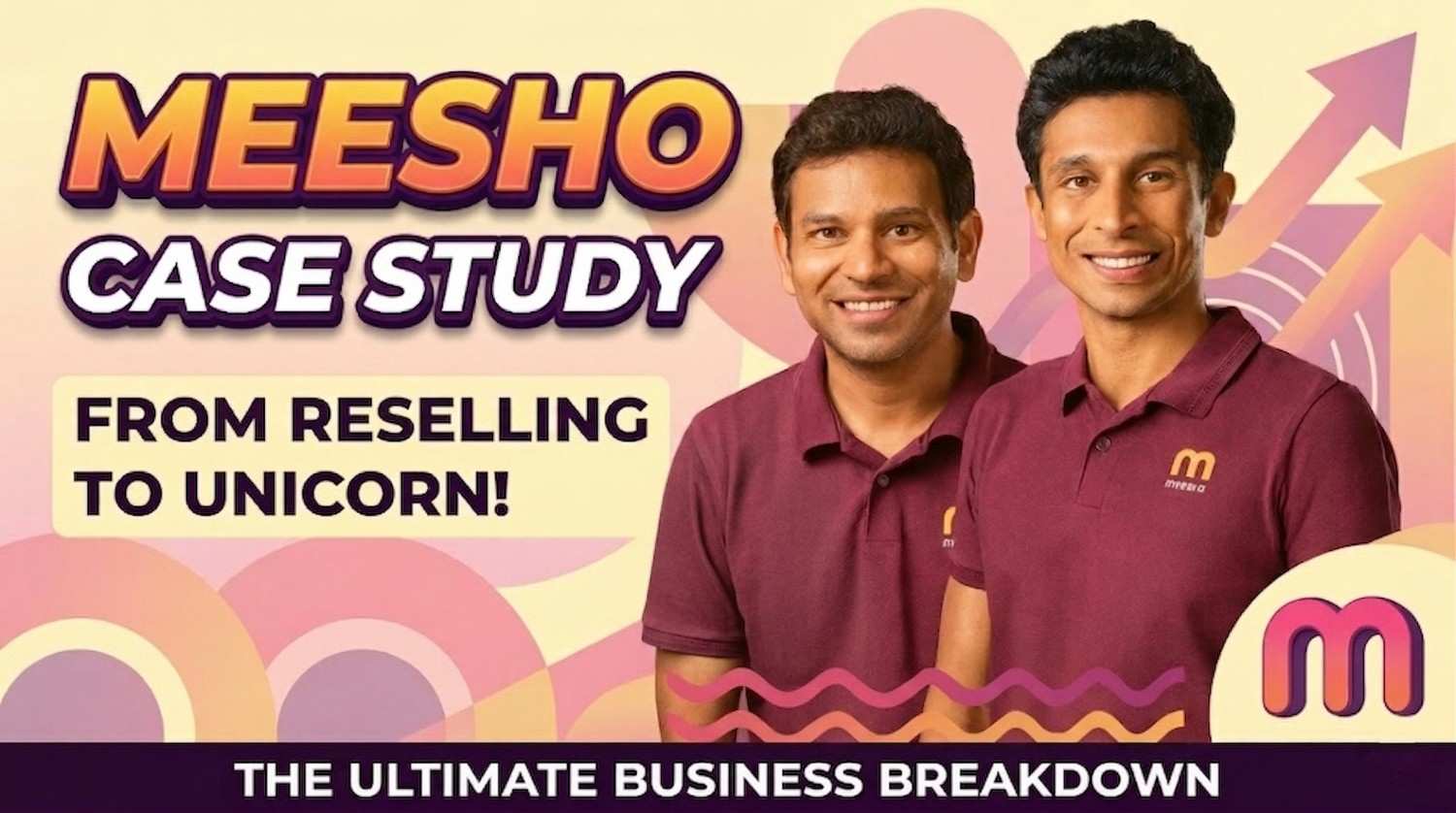
Two Boys from Meerut Who Made It to IIT
Vidit Aatrey grew up in a two-bedroom apartment in North-West Delhi. His father worked at the Delhi Jal Board. The family was not poor, but money was always something to be careful with. There was no startup culture at home, no entrepreneurs in the family, no safety net if things went wrong.
Sanjeev Barnwal had a similar background, also from Meerut. Both of them worked hard enough to get into IIT Delhi, which in India is one of the hardest things a student can do.
They became hostel neighbours. Their rooms were diagonally opposite each other. They became close friends, the kind who talk late into the night about what they want to do with their lives.
After graduation, they went in different directions. Vidit joined ITC, then moved to InMobi in Bengaluru. Sanjeev flew to Japan and joined Sony's core technology team, working on camera hardware for DSLRs and mobile phones.
Both had good jobs. Both were quietly restless.
The First Idea That Did Not Work
In June 2015, Sanjeev flew back from Japan and both of them quit their jobs.
The idea they started with was called Fashnear. Think of it as a Swiggy for clothes. You could browse products from local fashion shops in your neighbourhood, order them, and get them delivered home. You could even try clothes before buying.
Vidit has described what those early months looked like. He and Sanjeev would spend full days going from shop to shop, photographing every item, cataloguing each product on the app themselves. Then Vidit would act as the delivery person, carrying orders to customers — not because they could not afford delivery staff, but because he wanted to hear feedback directly from people the moment they received something.
They even stood on streets in Bengaluru holding signs to get people to download the app.
This is the kind of founder commitment that rarely makes it into press releases, but almost always precedes something important.
Despite all of this effort, Fashnear was not working. The model was too complicated to run consistently. Managing local shop inventory, coordinating deliveries, handling returns — it was operationally messy and difficult to scale.
So they shut it down. But something they noticed while talking to customers planted an entirely new idea.
The WhatsApp Sellers Nobody Had Noticed
While visiting homes during Fashnear deliveries, Vidit started noticing something.
Women in small towns and residential societies were already selling things informally. Sarees, kurtis, home decor, jewellery. They would collect catalogues from local suppliers, photograph the pages, and share them on WhatsApp groups with friends and neighbours. Someone would say “I want this,” and the seller would place the order, collect the money, and deliver it personally.
No app. No business registration. No investment. Just a phone, a WhatsApp group, and trust within a community.
The key insight:
These women were not waiting for an e-commerce platform to enable them. They were already doing it — just with no support system behind them. No proper supplier network, no logistics, no payment infrastructure, no way to grow beyond their immediate social circle.
Vidit and Sanjeev realized this was the business. Not building another way for people to buy things online. But building the infrastructure that allowed ordinary people to become sellers themselves.
Meesho is Born. The Name Means “My Shop.”
In 2016, they relaunched. The new platform was called Meesho, short for “Meri Eshop,” which means “My Shop” in Hindi.
The model was simple. A supplier listed products on Meesho. A reseller — anyone with a phone — could browse the catalogue, add a margin on top of the price, and share the product with their network on WhatsApp, Facebook, or Instagram. When someone bought it, Meesho handled the packaging, delivery, payment, and returns. The reseller never touched the product and never needed any money upfront.
To start a business on Meesho, you needed exactly zero rupees. That was the whole point.
The same year, Meesho became the first Indian startup selected for Y Combinator's accelerator program. Getting into YC as an Indian startup in 2016 was extremely rare. It gave them credibility, connections, and a sharper way of thinking about the business they were building.
Facebook Bets on the Invisible Customer
In 2019, something historic happened.
Facebook made its very first investment in an Indian startup. That startup was Meesho.
This was not just a financial milestone. It was a signal. Facebook, a company built entirely on social networks and communities, saw in Meesho something that nobody else had fully understood yet. Commerce was moving to social. People trusted recommendations from people they knew far more than they trusted ads or product listings.
Growth by the numbers
February 2019: 209,000 resellers and 1.2 million orders per month
March 2020: 563,000 resellers and 3.1 million orders per month
All of this driven by word of mouth inside WhatsApp groups across small-town India.
Multiple Pivots Before the Real Breakthrough
What most people do not know about Meesho is that the company went through several pivots before it found the model that truly worked.
At one point, the founders tried running two separate products inside the company at the same time. One focused on the original social reselling model. The other was called Meesho Supply, a managed marketplace designed specifically to serve micro-entrepreneurs across India with access to national suppliers.
Meesho Supply was doubling in scale every single month.
Vidit and Sanjeev looked at the data and made a hard call. They could not run both at full effort. They shut down the original track and put everything into the supply-side marketplace model. Eventually, Meesho Supply simply became Meesho.
The hardest startup decision is killing something that works moderately well.
This decision — to shut down something working to double down on something working extraordinarily well — is one of the most important moments in the company's history.
COVID Accelerated Everything
When the pandemic hit in 2020, the entire country was stuck at home.
For Meesho's resellers, this was actually an opportunity. People had more time. WhatsApp groups were more active than ever. Neighbours were talking to each other more. Online shopping was becoming normal for people who had never tried it before.
Meesho's order volumes jumped. New resellers joined in large numbers, many of them people who had lost income from other sources and were looking for a way to earn from home.
In April 2021, Meesho raised $300 million from SoftBank Vision Fund at a valuation of $2.1 billion. They became India's first social commerce unicorn. More importantly, they became the first shopping app to reach 500 million downloads on Android, making them the fastest app to hit that number in Indian history.
By 2023, Time magazine named Meesho one of the most influential companies of the year. They were in the same list as OpenAI and other globally recognized names.
Competing With Amazon by Not Competing With Amazon
Here is the strategic choice that most people overlook when they study Meesho.
Vidit never positioned Meesho as a competitor to Amazon or Flipkart. He explicitly said so. Instead of fighting for the customer who was already buying online, he went after the 500 million Indians who were not buying online yet — and the even larger number who had never considered selling.
This meant Meesho made decisions that looked strange from the outside. They kept prices low by charging zero commission to sellers for a long period of time. They invested in cash on delivery. They built for users who typed in Hindi and regional languages, not English. They made the app work on older, cheaper phones with slow internet connections.
Every one of these decisions reduced their short-term revenue. Every one of them built long-term loyalty with a customer segment their competitors had ignored.
By December 2024, Meesho had approximately 187 million annual transacting users and processed 1.3 billion orders between April and December 2024 alone. Those are not niche numbers.
A Business That Stayed Profitable While Others Burned
By 2023 and 2024, the Indian startup world was experiencing a brutal correction. Funding dried up. Companies that had grown on investor money without building sustainable business models were collapsing.
Meesho was in a very different position.
Unlike most high-growth startups, Meesho maintained positive cash flow. Their customer acquisition cost was low because resellers brought their own customers through personal relationships. Their operational model had been built carefully, not lavishly. They had not burned money on Super Bowl-style marketing campaigns or celebrity brand ambassadors.
In December 2025, Meesho went public on Indian exchanges, raising $603 million. It was one of the most anticipated IPOs in India's startup history.
What You Can Take Away From This
The ignored customer is often the biggest opportunity.
Every major e-commerce company in India was chasing the same urban, digitally comfortable buyer. Meesho went the other way. The most underserved customer in your market is usually the one worth building for.
Watch what people are already doing before you build.
Vidit spotted women selling on WhatsApp informally during Fashnear deliveries. He did not invent social commerce. He watched it happening and built the infrastructure around it. The best product ideas often come from observing behavior that already exists.
Kill the thing that is doing okay to save the thing that is doing great.
Running two products simultaneously is rarely sustainable. Meesho shut down a working model to go all in on a better one. This is a difficult call, but it is often the right one.
Zero investment is a product feature.
"No money needed to start" was not just a marketing line. It was a deliberate product decision that unlocked a completely different category of entrepreneur. Think about what barriers your product could remove entirely, not just reduce.
Compete in a different arena entirely.
Meesho never tried to out-Amazon Amazon. They served a customer Amazon was not trying to serve. The most sustainable competitive advantage is often going where the big players are not looking.
The Numbers
| Milestone | Detail |
|---|---|
| Founded | December 2015 |
| First product | Fashnear (hyperlocal fashion delivery) |
| Relaunched as Meesho | 2016 |
| YC Batch | 2016 (first Indian startup selected) |
| Facebook investment | 2019 (Facebook's first Indian startup investment) |
| Unicorn status | April 2021 ($2.1 billion) |
| Current valuation | $4.9 billion |
| Total resellers on platform | 13 million+ |
| Women resellers | Over 10 million |
| Annual transacting users | 187 million (December 2024) |
| Orders (Apr to Dec 2024) | 1.3 billion |
| App downloads | 500 million+ |
| IPO | December 2025, raised $603 million |
Meesho did not build a shop. It gave millions of people who never imagined owning a business their own shop — for free, on their phone. Most of them were women. Most of them lived in towns that Amazon had never prioritized. That is not just a startup success story. It is a quiet social shift that happened on WhatsApp groups, one catalogue share at a time.