This is a real story from a logistics startup founder who got a DPIIT rejection letter and had no idea what went wrong. If you are afraid to apply because you think you will get rejected, or if you already got rejected and feel stuck, this one is for you.
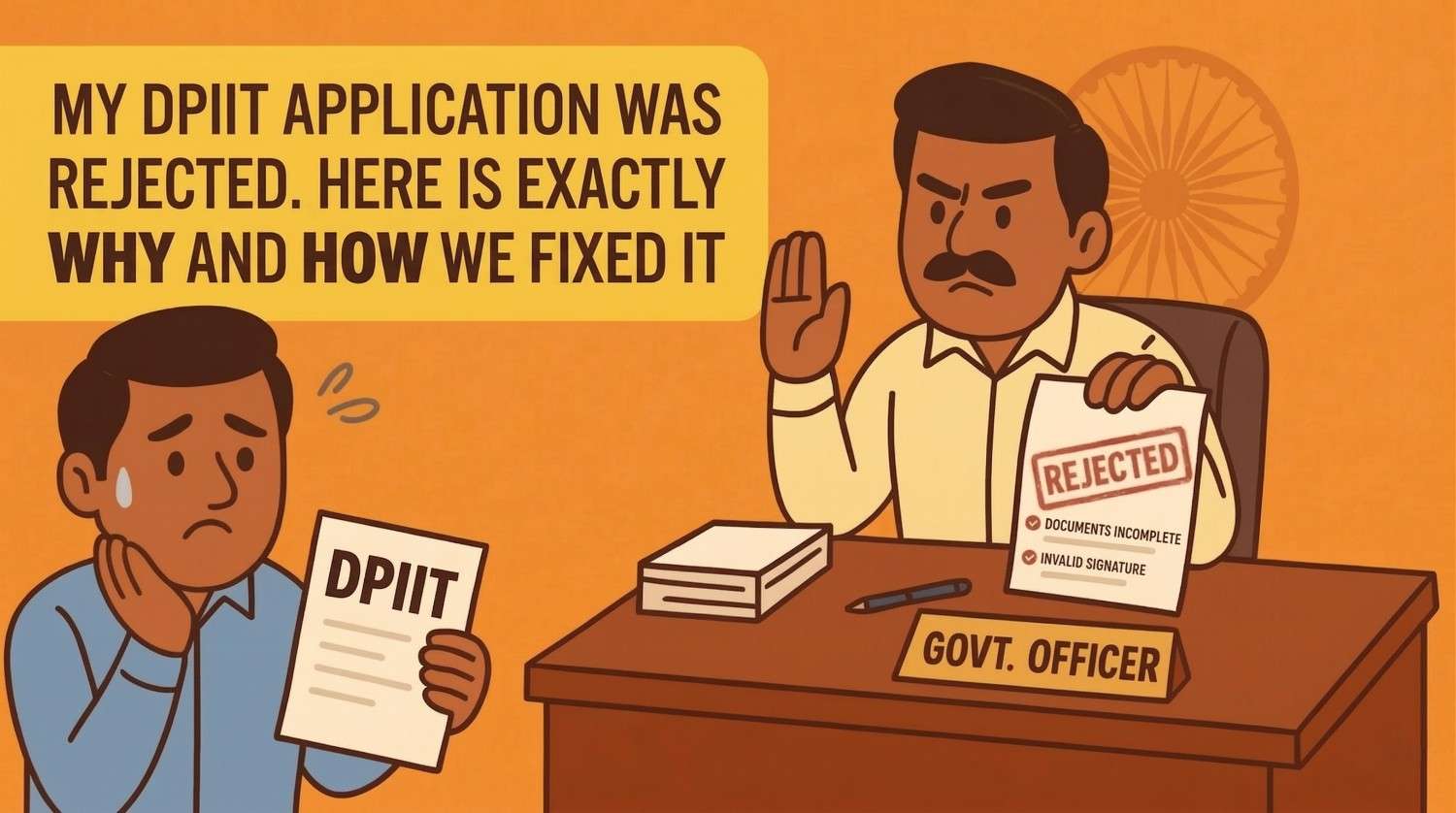
Table of Contents
- 1. The Day the Email Arrived
- 2. What Actually Went Wrong: The 4 Real Mistakes
- 3. How We Rebuilt the Application From Scratch
- 4. What DPIIT Actually Wants to See
- 5. The Second Attempt and the Approval
- 6. What the Recognition Unlocked for Our Business
- 7. My Honest Advice If You Are In The Same Spot
The Day the Email Arrived
It was a completely normal Tuesday afternoon. I was at our warehouse in Navi Mumbai, dealing with a last-mile delivery delay that had been frustrating our biggest client all week. My phone buzzed and I saw an email from the DPIIT portal. I thought it was the approval we had been waiting for the past two months.
It was not. The subject line said: Application for Startup India Recognition: Rejected.
I remember standing there, reading that email three times, trying to make sense of it. We had put in so much work. Our company had been running for two years. We were creating real jobs. We had technology driving our route optimization. But apparently, none of that was enough. The rejection felt personal. It felt unfair.
And honestly? Looking back now, after we successfully got our recognition six months later, I completely understand why we were rejected. We were making classic mistakes that a lot of founders make. I just wish someone had warned us about them before we hit send on that first application.
What Actually Went Wrong: The 4 Real Mistakes
After we got the rejection, we sat down with a proper advisor and went through our application line by line. What we found was embarrassing in hindsight but completely understandable given that we had no guidance when we first applied. Here is every single thing we got wrong.
We Called Ourselves a Logistics Business, Not an Innovative One
The problem: Our application described our company as a logistics and supply chain management business. That is technically accurate. But from the DPIIT's perspective, it sounded like a traditional trading or service company. There was no mention of what made us different or how we were solving problems that existing logistics companies were not.
What we fixed: We completely rewrote our business description to lead with our technology first. We talked about our proprietary route optimization system, the real-time tracking layer we had built for our clients, and how our platform was reducing delivery failures by over 30 percent compared to industry averages. Same business. Completely different framing.
Our Business Model Section Was Vague and Generic
The problem: We wrote something like 'our company charges clients on a per-delivery basis and aims to expand across Maharashtra.' That is not a scalable business model description. That is a sentence that tells the reviewer nothing meaningful about how the business creates value or how it grows.
What we fixed: We described our actual model in detail. We explained our SaaS component for corporate clients, the embedded logistics partnerships we had built, and how adding a new geography did not require proportional cost increases because our technology handled the complexity. We showed that this business could grow without just adding more trucks and more headcount.
Our ITR Did Not Match What the Application Said
The problem: Our income tax return for the previous year showed us operating as a logistics service provider. But in our DPIIT application, we mentioned a technology platform and software tools as core parts of our offering. The DPIIT cross-checks your financial filings. When your declared income and your business description do not tell the same story, that is a direct red flag.
What we fixed: Before reapplying, we worked with our CA to update how our revenue and expense categories were reported. We also made sure our business website, GST filings, and the application itself all used consistent language to describe what we actually do.
We Skipped the Innovation Narrative Entirely
The problem: The DPIIT's core criterion is that your business must be working toward innovation, improvement, or development of a product, process, or service. We had real innovation happening inside our operations. We had built internal tools. We had a proprietary driver management system. But none of this was mentioned anywhere in our first application.
What we fixed: We wrote a dedicated section describing every piece of innovation, technology, or process improvement we had built since the company started. We framed it clearly as tech-driven logistics rather than a traditional logistics company that happened to use some software.
How We Rebuilt the Application From Scratch
After identifying our mistakes, we did not just patch the old application. We threw it away and started over. Here is the process we followed, step by step.
First, we booked a consultation with a startup compliance expert. We had tried doing this ourselves the first time and it cost us months of delay. Having someone who had handled DPIIT applications before made a massive difference. They knew exactly what reviewers are looking for and what kinds of language tend to raise red flags.
If you are at this stage and looking for guidance, the team at Startup India Info offers dedicated DPIIT recognition support that covers application drafting, document review, and compliance alignment. That kind of specialist help is exactly what we needed and did not have the first time.
Second, we did a full audit of every document we were attaching. Our incorporation certificate, our bank statements, our company website, our pitch deck, our ITR. Everything had to say the same story. Consistency was the single biggest lesson we took away from our first failure.
What DPIIT Actually Wants to See
Let me save you the 60 days I wasted on my first application by summarizing what the DPIIT is genuinely looking for. Think of the reviewer as someone who is reading hundreds of applications a week. They want to quickly understand three things about your business.
Is There Real Innovation Here?
This does not mean you need to have invented something completely new. It means you need to show that your business is solving a real problem in a way that is meaningfully better than existing alternatives. For us, the innovation was using data and software to reduce delivery failures in an industry that was still running mostly on phone calls and manual tracking. That is legitimate innovation. We just had to say it clearly.
To strengthen your case here, read up on what DPIIT startup recognition actually means so you understand the exact definition they use for an eligible startup.
Can This Business Scale Without Linear Cost Growth?
The government wants to recognize businesses that can grow significantly without needing proportionally more money, people, or physical infrastructure at every step. A pure trading business or a traditional service business without any technology or process leverage typically does not meet this bar. If your business has a tech component, a data asset, a proprietary process, or an integrated platform, highlight it aggressively. That is your scalability story.
Does This Create Jobs or Wealth at Scale?
Even if you do not have a strongly tech-led model, you can qualify if you can demonstrate that your business has high potential to create employment or generate wealth at scale. If your logistics business, for example, is building a franchise model or creating gig economy opportunities for drivers across multiple cities, that is an employment creation story. Make it explicit in your application.
The Second Attempt and the Approval
We submitted our revised application in early November. The waiting period the second time around felt even longer than the first, because now we actually knew what was at stake. We had already seen what a rejection looked like. We did not want to see it again.
About 52 days after submission, we got a new email. This time the subject line read: Congratulations! Your Startup India Recognition has been approved.
I will not pretend I was calm about it. I called my co-founder immediately and we sat in the warehouse car park for twenty minutes just processing it. Two years of running this business, one painful rejection, months of rebuilding, and finally, we were officially a recognized startup.
What the Recognition Unlocked for Our Business
I want to be honest here. The benefits did not rain down on us the day after we got the certificate. Recognition is not automatic money or contracts. It is a door opener. But it is a very powerful one.
The first thing that changed was our credibility with corporate clients. We were pitching to three large e-commerce companies at the time and all of them asked about our compliance and government registration status in their vendor questionnaires. Being a DPIIT recognized startup meant we could say yes to both the right business structure and government backing question.
Second, our CA immediately began the process of applying for the three year income tax holiday under Section 80 IAC. That kind of tax relief, when you are a growing startup reinvesting everything back into the business, is not a small thing. Every rupee saved on tax is a rupee that goes into fleet, into people, into software.
You can read the full details on how this benefit works here: Income Tax Exemption for DPIIT Recognized Startups.
Third, when we later raised a small seed round from an angel investor, the recognition gave us an advantage we had not expected. Our angel tax exposure was completely eliminated. Without that exemption, any investment above fair market value would have been taxed as income. Recognition removed that risk entirely. More on that: No Angel Tax for DPIIT Recognized Startups.
My Honest Advice If You Are In The Same Spot
If you just got a rejection, first, breathe. It is not the end. I promise you it is fixable. Here is what I would tell myself if I could go back to that Tuesday afternoon in the warehouse.
- 1
Do not reapply with the same application. Read the feedback you received, even if it is vague. Then sit with a specialist who can read between the lines of what DPIIT flags as a concern.
- 2
Make your innovation the first sentence of your application. Not buried in paragraph four. The reviewer forms an opinion within the first few sentences. Lead with what makes you different.
- 3
Check every document for consistency. Your ITR, GST filings, website, and application all need to tell the same story about what your business does.
- 4
Get professional help for the reapplication. I know it feels like something you should be able to do yourself. Maybe you can. But if your first attempt failed, the cost of expert guidance is nothing compared to another rejection and another three months of waiting.
- 5
Do not wait until you think you are ready. A lot of founders keep delaying their DPIIT application because they feel their business is not innovative enough yet. If you have been operating for less than ten years, have a turnover under Rs 100 crore, and you can describe an innovation angle, you are likely eligible right now. Start the conversation today.
If you are unsure whether your business qualifies, or if you want someone to review your existing application before you resubmit, the best starting point is to simply talk to someone who has been through this process many times. You can reach the Startup India Info team directly here and get a clear, honest assessment of where you stand and what needs to change.
And if you have never applied before but you have been putting it off because you are worried about rejection, I hope this story gives you a little courage. Yes, rejection is a real possibility. But it is a problem you can fix. The benefits waiting on the other side of that approval, the tax holidays, the angel tax exemption, the government credibility, the access to funding, are absolutely worth the fight.
Got rejected? Let us fix it together.
Our team reviews your application, identifies exactly what went wrong, and helps you resubmit with confidence. No guesswork. No waiting in the dark.